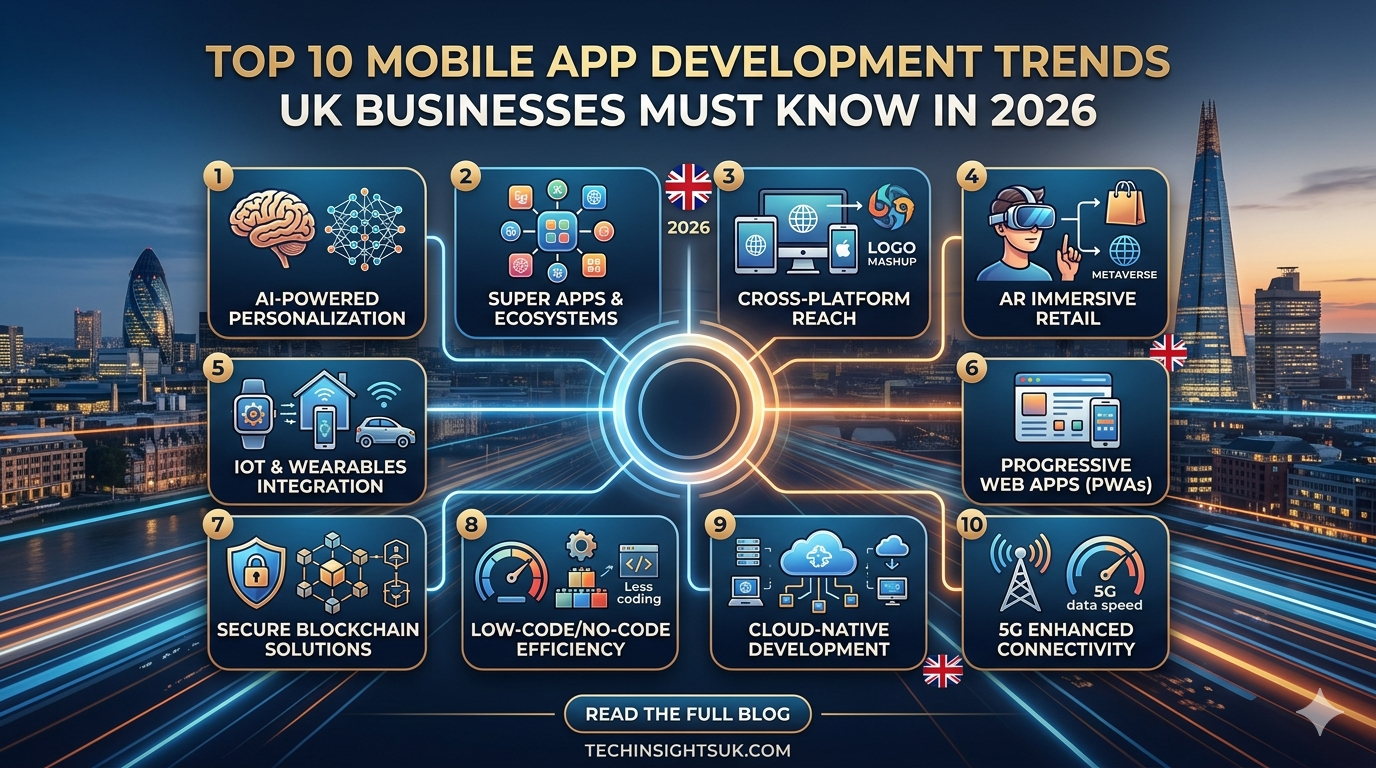
The UK’s mobile app market is evolving at a pace no business can afford to ignore. With over 55 million smartphone users across Britain and consumer expectations at an all-time high, staying ahead of the curve is no longer optional — it’s survival. Whether you’re a startup in Manchester or an enterprise in London, partnering with the right mobile app development company could define your competitive edge this year.
Here are the top 10 trends reshaping mobile app development in the UK in 2026.
1. AI-Native App Experiences
Artificial intelligence has moved from a feature to a foundation. In 2026, leading UK businesses are embedding AI directly into the core architecture of their apps — powering real-time personalisation, predictive UX, and conversational interfaces. Any forward-thinking app development agency now treats AI integration as a baseline expectation, not a premium add-on.
2. On-Device AI and Edge Intelligence
Following strict UK GDPR regulations and growing user privacy concerns, processing AI workloads on-device — rather than in the cloud — has become a dominant architectural choice. This reduces latency, improves data security, and enhances offline performance. Skilled mobile app developers are now designing apps that run powerful models locally on iOS and Android hardware.
3. Super Apps Are Coming to the UK
Inspired by Asia’s WeChat and Alipay models, UK consumers are warming to super apps — single platforms offering payments, shopping, messaging, and services in one place. Retailers, fintech players, and healthcare providers are exploring this model heavily. A specialist mobile app development company with experience in modular architecture is essential to build these complex ecosystems right.
4. Augmented Reality Goes Mainstream
From virtual try-ons in fashion retail to AR-guided property tours in the real estate sector, augmented reality is no longer a novelty in UK apps — it’s expected. ARKit and ARCore capabilities are mature, and Apple Vision Pro’s influence is filtering into mobile UX design norms. Your app development agency should be actively prototyping AR-first user journeys today.
5. Voice-First and Conversational Interfaces
With voice search accounting for a growing share of UK consumer queries, apps built with voice-first interaction models are gaining serious traction. Beyond virtual assistants, conversational UI is being baked into banking apps, healthcare platforms, and e-commerce experiences. This requires mobile app developers who understand NLP pipelines and accessibility-first design.
6. Instant Apps and Progressive Web Apps (PWAs)
UK users increasingly resist downloading apps they’ve never tried. Instant apps (try-before-install) and PWAs solve this friction — offering near-native performance through the browser without an App Store download. For UK businesses targeting older demographics or lower-bandwidth regions, PWAs in particular deliver strong ROI and faster go-to-market timelines.
7. Sustainability-Driven Development
Environmental, Social, and Governance (ESG) priorities are reshaping UK business strategies, and software is no exception. “Green coding” — writing energy-efficient apps that reduce battery drain and server load — is becoming a genuine differentiator. UK enterprises are increasingly asking their mobile app development company to report on the carbon footprint of digital products.
8. Hyper-Personalisation Through Behavioural Data
Gone are the days of generic push notifications. In 2026, UK apps leverage real-time behavioural signals — browsing history, location patterns, in-app gestures — to serve hyper-relevant content and offers. When implemented with proper consent frameworks under UK data law, this drives measurable increases in retention and lifetime value.
9. Fintech and Open Banking Integration
The UK remains one of the world’s most advanced open banking markets. Apps across industries — from retail to healthcare to HR — are embedding financial features: instant payments, salary advances, spend analytics, and insurance products. Choosing an app development agency with fintech experience and FCA compliance knowledge is critical for any business pursuing this route.
10. Cross-Platform Development at Scale
The Flutter vs React Native debate has matured into a practical decision framework. UK businesses with tight budgets and fast timelines favour cross-platform solutions, while those needing deep hardware integration lean native. In either case, experienced mobile app developers who understand when to go cross-platform — and when not to — deliver significantly better outcomes than those applying a one-size-fits-all approach.
What This Means for UK Businesses
The businesses winning in 2026 are those treating mobile not as a project, but as a product — something continuously evolved, measured, and optimised. That demands more than just technical execution; it requires strategic partnership.
Whether you’re building from scratch or modernising a legacy app, working with experienced mobile app developers who understand the UK regulatory landscape, consumer behaviour, and emerging technologies is what separates successful digital products from expensive failures.


Leave a Reply